|
|
| The
University of Copenhagen |
The
University of Copenhagen |
Founded
in 1479 - by King Christian I |
Online
& Onsite Sightseeing - Copenhagen |
| The
University of Copenhagen from 1836 is centrally located in the old
Latin quarter of Copenhagen. |
The
University of Copenhagen
The University of Copenhagen is the first
university in Denmark and founded in 1479
by King Christian I (1426-1481 - ruled Denmark,
Norway and Sweden from 1448-1481) after the approval of its
establishment by Pope Sixtus IV was granted.
The
University was a centre of Roman Catholic theological learning
- but also had faculties of Law - Medicine and Philosophy.
With its more than 525 years - the University
of Copenhagen is one of the oldest universities
in Northern Europe.
See: Copenhagen's History |
|
|
The
Founder - King Christian I |
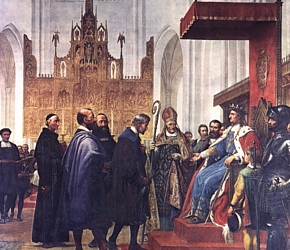
The
founder of the University of Copenhagen King Christian I,
during the inauguration ceremony of the University in 1479
at Copenhagen's Cathedral. The painting was created by Wilhelm
Marstrand in 1870. |
|
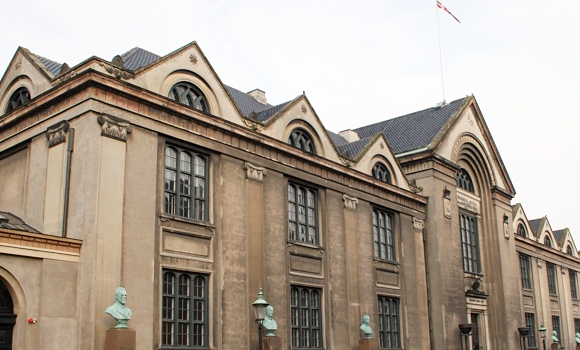
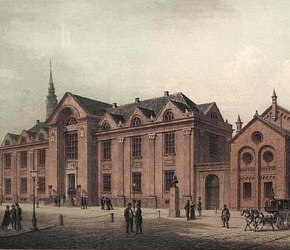
The
new University buildings in 1860 that was inaugurated in 1836
under the reign of King Frederik VI, with his name "Fredericus
Sextus" carved on the entrance. See top photo. |
|
Radical
changes in Governance
As
other medieval universities, the University of Copenhagen
was a part of the universal Roman Catholic Church until the
reformation in 1536. The University was re-established
by King Christian III (1609-1670 - ruled
Denmark and Norway 1648-1670) in 1537 - where
the position and role of the University in Danish society
meant a radical change. In 1771 the university
lost its own jurisdiction and in the middle of the 20th
Century the so called "professorial
power" was finally abolished during 1960s.
From
the inauguration in 1479 until 2004
- the university was led by a Rector and a Consistory - but
governance of the University changed radically during 2004
- where the Consistory was replaced by a Board of Governors. |
|
|
The
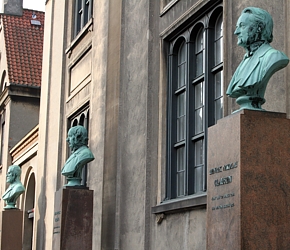
University five busts |
In
front of the University five busts on stands are placed of
former scholars from different faculties of the University,
of which one is The Danish Nobel Prize award winner in Physics
1922, Niels Bohr. |
|
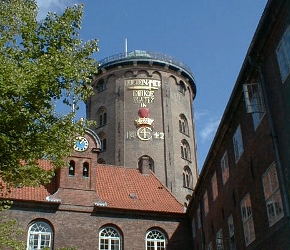
Regensen
is the collegium for students at the University of Copenhagen
and is situated beside the Round Tower from 1642. The dormitory
from 1623 was rebuilt after the heavy fires in 1728. |
|
Fredericus
Sextus
During
the bombardment of Copenhagen in 1801 the
university's buildings was ruined. The construction of new
buildings started in 1831 and inaugurated
in 1836 - in the old Latin quarter of Copenhagen
during the reign of King Frederik VI (1768-1839
- ruled from 1808-1839). The entrance is carved with his name
- Fredericus Sextus.
The Copenhagen University Library
The library of the University was established in
1482 - and was placed closed up to the main
buildings. In 1653 the entire library was
move to the attic of the Trinitatis Church
beside the Round Tower. During the fires of Copenhagen in
1728 - nearly all the 30,000 books
were destroyed. The library was slowly re-established and
in 1861 the library moved into new premises
at Fiolstræde. Today the library of the University is
a part of the Royal Library.
See:The Royal Danish Library
|
|
|
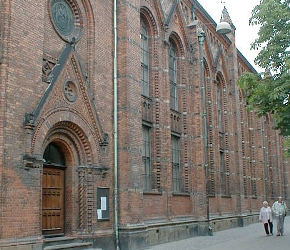
The
University library
from 1861 |
The
Library of the University from 1861 is located right beside
the premises of the campus. |
|
|
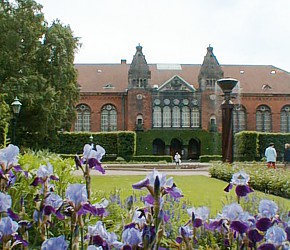
The
Royal Library and The University Library
|
|
The
University Library from 1861 is a part of the Royal Library
- located beside the Danish Parliament. |
|
Prominent
and world famous Danes & Scholars
Educated at The University of Copenhagen |

|
Søren
A. Kierkegaard
(SAK - 1813-1855)
Søren A. Kierkegaard Danish
philosopher and defender of religious faith -
was born in Copenhagen - where he also spent all
his days. In 1830 - 17 years
old - Kierkegaard entered the University
of Copenhagen - where he studied theology
- philosophy - and literature. He
matriculated in theology in 1840
- and in 1841 - he also earned
a Master’s degree - which corresponded then
to a doctoral degree. Søren
A. Kierkegaard is interpreted as a momentous and
leading figure in contemporary thought as well
as a modern existentialist - humanist
and individualist.
At The Museum of Copenhagen one can find the Søren
A. Kierkegaard Collection - which is
a permanent exhibition of the philosopher.
Søren
Kierkegaard died at the age of
42 - and his funeral was held
at The Cathedral of Our Lady with the following
burial at Assistens Cemetery.
In
1994 the Søren
Kierkegaard Research Centre was founded
- with the entire Kierkegaard library.
See: Søren
Aabye Kierkegaard
|
|
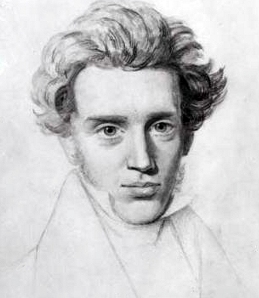
Søren
A. Kierkegaard - 1840 |
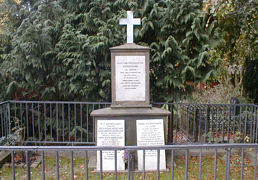
| Søren
A. Kierkegaard's final resting place at Assistens
Cemetery. |
|
N. F. S. Grundtvig (1783-1873)
The
Danish Priest and Philosopher Nicolai
Frederik Severin (N.
F. S.) Grundtvig - is a person
of great magnitude and influence in newer Danish
history. He was a pastor at The Church of Our
Saviour for four years 1822-1826.
Grundtvig entered the University
in 1800 - 17 years old - where
he studied theology and literature. He matriculated
in theology in 1803 - 20 years old.
Grundtvig was besides being a teacher -
author - poet - philosopher - historian - pastor
- hymn writer and even politician - he
also reformed Christianity within the Danish
Lutheran Church - and developed The Folk
High School movement - and the Grundtvigian
movement.
Last but not least - Grundtvig put a clear fingerprint
on developing Denmark into a free and democratic
country - and was a warm supporter
of women's rights. During his
time at Our Saviour Church he was given life
censorship - on behalf of his many
written theological works - and as a protest
he resigned from all of his duties in 1826.
(This Portal will later portrait N.S.F. Grundtvig
in a more comprehensive and deserving manner).
Grundtvig is buried at Claras Kirkegaard (Claras
Church Cemetery) at estate Gammel Kjøgegaard
- 20 km south of Copenhagen.
See:
Grundtvig's Church |
|

Painting
of N.S.F Grundtvig from 1843. |
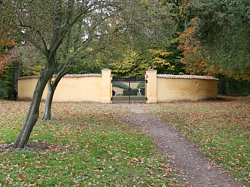
Grundtvig's
final resting place at Claras Kirkegaard (Claras
Church Cemetery) at estate Gammel Kjøgegaard
- 20 km south of Copenhagen. |
|
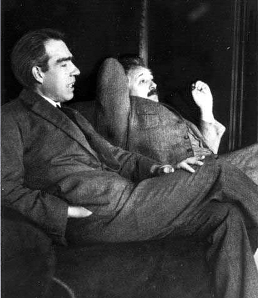
Niels
Bohr and Albert Einstein in 1925. |
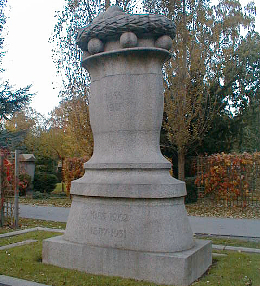
| Niels
Bohr's burial plot at Assistens
Cemetery. |
|
Niels Bohr (1885 1962)
The Nobel Prize award winner
in Physics 1922 - Niels Bohr entered
the University of Copenhagen
1903 - where he took his Master's degree
in Physics in 1909 - and his
Doctor degree in 1911. In 1916
he was appointed Professor of
Theoretical Physics at Copenhagen University
- and since 1920 (until his death
in 1962) he was the head of the Institute for
Theoretical Physics - established for him at that
university and called The
Niels Bohr Institute
The Niels Bohr Institute
The Niels Bohr Institute is the unification of
the four earlier institutes for the physical sciences
at Copenhagen University: The Astronomic
Observatory - The Ørsted Laboratory - The
Geophysical Institute and The
Niels Bohr Institute. The Institute house
10 research groups and
12 science centers - of which the five
conduct fundamental research. Scientific research
is conducted in collaboration with many leading
international research groups.
Study and Education
The Niels Bohr Institute educates the students
in the subjects of Physics and
Astronomy and among the areas
in the physics study is geophysics
- particle physics - quantum
physics - biophysics
and nanotechnology. The Institute
offers students a 3-year bachelor degree followed
by a 2-year graduate degree and a 3-year PhD study.
Final
resting Place
Niels Bohr died in 1962
and buried at a family plot at Assistens Cemetery.
|
See:
Copenhagen's History
|
Other
historical & legendary Scholars
Educated at The University of Copenhagen |
|
|
Ole Rømer (1644–1710)
Danish astronomer - discovred the first quantitative
measurements of the speed of light.
|
|
|
|
Ludvig
Holberg (1684-1754)
Metaphysics - rhetoric and history
Ludvig Holberg is considered the founder
of modern Danish and Norwegian literature and comedies.
|
|
|
|
H.C. Ørsted (1777-1851)
Physics
Ørsted discovered that electric
currents create magnetic fields - which was the
first connection found between electricity and
magnetism.
See: Copenhagen's
History
|
|
|
|
Peter
Ludvig Panum (1820–1885)
Danish physiologist and pathologist -
The Panum Building in Copenhagen is named in his
honor. |
|
|
|
Georg Brandes (1842-1927)
Aesthetics
Brandes - a Danish critic and scholar - who greatly
influenced Scandinavian and European literature
from the 1870s.
|
|
|
|
Niels Finsen (1860-1904)
Physician and scientist
Nobel Laureate in Medicine - 1903 (Denmark’s
first Nobel Prize Award) The
Finsen Laboratory at Copenhagen University Hospital
is named in his honor. |
|
|
|
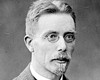
Johannes Fibiger (1867-1928)
Nobel Laureate in Medicine - 1926
Fibiger - a Danish physician and professor
of anatomical pathology at the University of Copenhagen.
|
|
|
August
Krogh (1874-1949)
Nobel Laureate in Medicine - 1920
August Krogh - a Danish professor
at the department of zoophysiology at the University
of Copenhagen from 1916 to 1945.
Besides his contributions to medicine - Krogh was
also one of the founders of the Novo Nordisk - a
global healthcare company with more than 90 years
of innovation and leadership in diabetes care.
The August Krogh Institute at Copenhagen University
Hospital is named in his honor.
|
|
|
|
Inge Lehmann (1888-1993) -
Seismologist and geophysicist
Inge Lehmann discovered in 1936 - that
the Earth has a solid inner core inside a molten
outer core.
|
|
|
|
Piet Hein (1905–1996)
Danish mathematician - inventor - designer
- author and poet.
Piet Hein advocated the use of the superellipse
curve in city planning - furniture making and other
realms. |
|
| This
lists of Scholars educated at The University of
Copenhagen will be updated frequently. |
|
|
The
largest educational institution in Denmark
The University of Copenhagen is the largest educational
institution in Denmark and offers several degrees
of education in a variety of subjects, ending
with a bachelor degree or master
degree that can be extended with three
more years of postgraduate work leading to a
Ph.D. degree. In 1788
the University had a teaching staff of around
20 permanent teachers and about 1,000 students.
At the beginning of the 21st
Century - the University of Copenhagen had 35,000
students and more than 7,000
scientific - technical and administrative employees.
Campuses
The University has several campuses located in
and around Copenhagen - with the oldest located
in central Copenhagen.
|
|
|
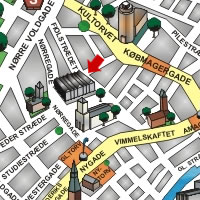
The
University of Copenhagen
Address
University
of Copenhagen
Nørregade 10
1017 Copenhagen K
Trains - Metro and S-train from Nørreport
Station
See: University
of Copenhagen
|
|
| The
University Site will be updated frequently!I |
|
|
|