|
|
| The
Round Tower of Copenhagen
|
The
Round Tower of Copenhagen...
...& The Trinitatis Church |
Online
& Onsite Sightseeing - Copenhagen |
| |
|
|
| |
10
- most popular tourist site |
|
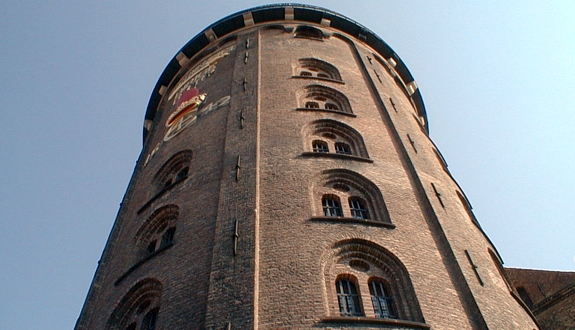
The
Round Tower was built as an observatory in 1642 by King
Christian lV. |
|
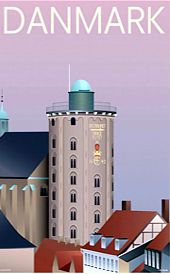
Round
Tower Vintage Poster |
|
The
Round Tower - King
Frederik II & Tycho Brahe
King Frederik II (1534-1588 – ruled Denmark
and Norway 1559 - 1588) was the first Danish King, who became
interested in astronomy due to the scientific work of Tycho
Brahe (1546-1601) - a famous Danish nobleman and
astronomer, who developed the “Tychonian” system,
which was a complicated astrological model of the solar system.
King Frederik II was very impressed with the many important
observations and results conducted by Tycho Brahe, that he
granted the funding to establish two observatories on the
island of Hven, which was situated in the
Sound between Sweden and Denmark. The new observatories was
built around 1576-1580 and named Uraniborg
and Stjerneborg, and the first of
its type in Denmark. The new astrological research institute
was equipped with a laboratory for astrological experiments
and many expensive astronomical instruments for precise measurements
of the universal system. |
|
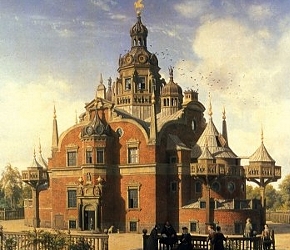
The
new astrological research institute and observatory
Uraniborg was placed on the isle of Hven and built around
1576 by astronomer Tycho Brahe with support by King
Frederik II, who was very interested in astronomy. |
|
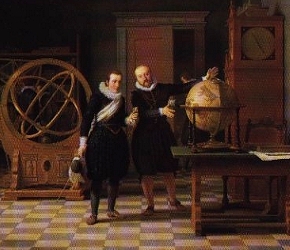
15
year old King Christian IV together with astronomer
Tycho Brahe at Uraniborg in 1592. Tycho Brahe left the
observatory on Hven 5 years later, due to a heavy dispute
between the King and him. He died in Prague 1601. |
|
King
Christian IV and Tycho Brahe
King Frederik II's son Prince Christian - later King
Christian IV (1577-1648 – ruled Denmark and
Norway 1588-1648) showed a great interest for astronomy too
and often visited Tycho Brahe at his Uraniborg observatory
on isle of Hven. As King Christian IV did not share the same
enthusiasm for Tycho Brahe’s scientific methods and
his interest for alchemy as his father had - Tycho Brahe fell
into disgrace with the new King, who stopped all further funding
of the two observatories on Hven. After the heavy dispute
with King Christian IV, Tycho Brahe left Hven in 1597
and moved later to Prague. Shortly after his death in 1601,
Tycho Brahe’s observatories Uraniborg and Stjerneborg
was demolished and leveled to the ground. |
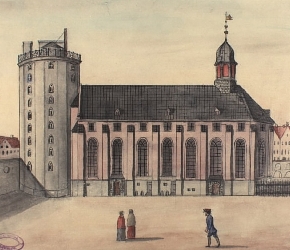
The
Trinitatis project and complex in 1749, with the Round
Tower from 1642 - The Trinitatis Church from 1656 and
the University library on the loft of the Chuch. The
complex was especially built for scholars and students
at Copenhagen’s University. |
|
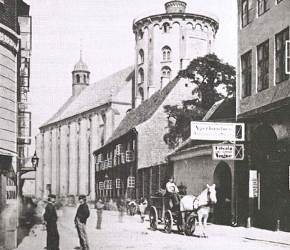
Picture
from 1870 of the Round Tower, where horse carriages
was a normal sight in the city. Trinitatis Church is
right at the back of the tower and the complex was situated
opposite the University Collegiums from 1840 called
Regensen. |
|
The
Trinitatis Complex
After Tycho Brahe’s Uraniborg and Stjerneborg was destroyed
and the lack of an having a scientific observatory in Copenhagen
for the scholars and students at Copenhagen’s
University – King Christian IV, who also was
known as the great architect and builder of Copenhagen, took
the initiative after advice from his own astronomer Christian
Longomontanus to establish a new observatory, in
the Latin Quarters of the City and named
it the Round Tower. The foundation stone
was laid in 1637 and was the first stage
of the King’s Trinitatis Complex, which
had the main objective to congregate three major facilities
for scholars and students at the University such as an astronomical
observatory – a University Church
and a University Library. |
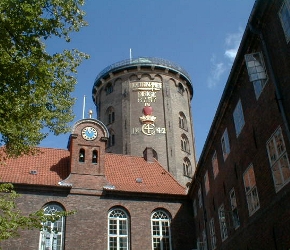
The
Round Tower at the back of the University dormitory
has a height of 36 m and the diameter of the tower is
15 m. The observatory functioned until 1861 and was
mainly used by the University. |
|
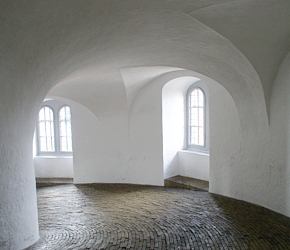
The
Round Tower is built with a 210 metre long spiral ramp,
which leads to the top of the observatory and planetarium,
as it was the King's wish to be driven by horse carriage
up to the top. |
|
The
Round Tower
The Kings original idea from the start was to build an observatory
identically like Tycho Brahe’s Stjerneborg
on the top of the Round Tower with the exact diameter like
Stjerneborg’s 15 m. The Tower was completed as an observatory
with a little planetarium in 1642 and has
a height of almost 40 m including the obsavatory.
The Round Tower is built with a 210 metre
long spiral ramp, which leads to the top, and on the uppermost
facade of the tower (Top photo) there is a gilded inscription
like a rebus. The rebus can be interpreted in the following
way: Lead God, the right teaching and justice into the heart
of the crowned King Christian IV, 1642 -
the year when the tower was completed. King Christian IV's
draft of it, written with his own hand, is kept at the Danish
Record Office.
The oldest functioning observatory in Europe
The Round Tower is the oldest functioning observatory in Europe.
Until 1861 it was used by the University
of Copenhagen - but today - anyone can observe the night sky
through the fine astronomical telescope of the tower in the
winter period. Legendary astronomers having used the observatory
include Ole Rømer (1644-1710) and
Peder Horrebow (1679-1764). As a curiosity
- a little piece of Tycho Brahe’s burial cloth
obtained from his final resting place in Prague is displayed
in the Round Tower’s collection. |
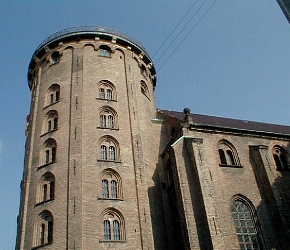
The
Trinitatis Church is built together with The Round Tower
and completed in 1656, which were several years after
the Round Tower was inaugurated by King Christian IV
in 1642. The loft was used as a library for the University
until 1861. |
|
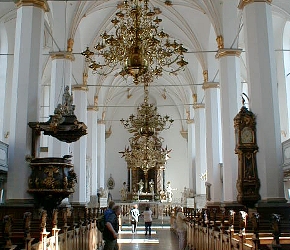
Trinitatis
Church altarpiece and pulpit originates from 1756-67.
In 1728 the church was damaged by a fire and was rebuilt
again in 1731. Under the Choir there is a tomb where
many prominent persons buried. |
|
The
Trinitatis church and University Library
As a part of the Trinitatis Complex, the
Round Tower is built together with Trinitatis church as it
was the King’s idea to build a University Church especially
for scholars and students at Copenhagen’s
University. The foundations stone was laid by the King in
1637 and the Church was inaugurated in 1656.
In 1728 the church was damaged by a fire
and was rebuilt again in 1731. The loft of
the Trinitatis Church was used as a library for the University
until 1861. The Altarpiece and pulpit is
from 1756-1767 and there is a tomb under
the Choir with many prominent persons buried. |
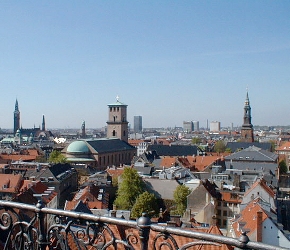
There
is a magnificent panorama view from the top of the Round
Tower over the old Latin Quarters and other historic
buildings in the Copenhagen skyline. In front are Copenhagen's
Cathedral and the tower of the Town Hall. |
|
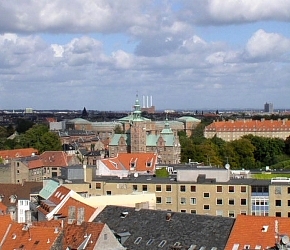
A view towards east and Rosenborg Castle from 1634.
One could easily imagine how King Christian IV experienced
the view to his beloved Castle for the first time 40
m. over ground level around 1640, and beyond to the
Sound and Sweden. |
|
Beautiful
view from the top
On the top of the Round Tower there is an exquisite view 40
m over the old part of Copenhagen and visitors can
see some of King Christian IV's buildings like Rosenborg
Castle - Old Stock Exchange (Børsen),
Naval Quarters (Nyboder) - The Town
Hall - Copenhagen's Cathedral and
much more. |
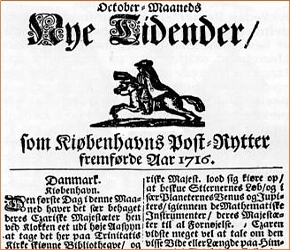
When
the Russian Czar Peter the Great and his Empress Catherine
I visited Copenhagen in 1716 - they drove up to the
top of the Round Tower in their Carriage, with the Czar
on horseback in front. The event created massive headlines
in the Copenhagen newspaper - Post-Rytter and was the
talk of the town for a long time. |
|
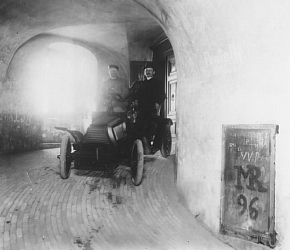
Many
types of attempts has been made to conqueror the top
of the Round Tower beside walking. In 1902 a German
tourist challenged his powerful German Beaufort car
and drove as the first motorized vehicle up and down
the spiral ramp. Beaufort was a German manufacturer
of automobiles, who existed from 1902 - 1919. |
|
Many
Challenging rides to the top
King Christian IVs historical monument and landmark -
The Round Tower – has been a subject for many challenging
actions with its special is 210 metre long spiral
ramp that leads to the top. In 1716,
the royal Empress Catherine I of Russia drove
up to the top of the Tower in a horse carriage, with her husband
Czar Peter The Great of Russia in front on
horseback, to enjoy the beautiful view over Copenhagen. The
happening created headlines in the newspaper and was the talk
of the town at that time. In 1902 a German
tourist visited Copenhagen in his new motorized vehicle, a
German Beaufort and drove his car to the
top of the tower, as first motorized vehicle
ascending the tower. A tradition every year in spring is the
one wheel cycle rally Unicycle) up and down
the towers spiral ramp and this very special arrangement by
the Royal Roundtower Unicycle Race organizers gathers many
participants and spectators. The world record
for this special sporting event - up and down the ramp - is
1 minute 48.7 seconds - and was set in 1989. |
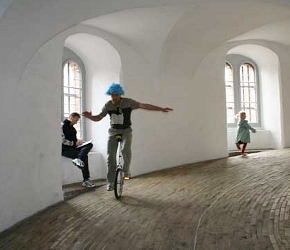
Many
different sports races and contest have been conducted
on the spiral ramp to pursuit a record. A tradition
every year in spring is the one wheel cycle rally up
and down the towers ramp. This very special event is
organized by the Unicycle Race Club and gathers many
participants and spectators. The world record for cycling
a one wheeler up and down the slope is 1 minute 48.7
seconds, and was set in 1989. |
|
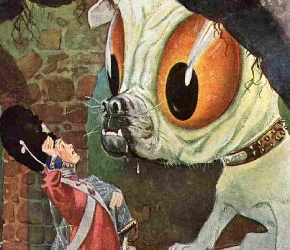
The
famous Danish story writer Hans Christian Andersen (1805-1875)
- wrote the little fairytale about " The Tinder
Box" in 1835 - where the brave soldier met an old
ugly witch, who told him about the old hollow tree with
the three loaded money-chest that could make him rich
- but were guarded by tree dogs - one with eyes as big
as saucers, one with eyes as big as mill wheels and
one with eyes as big as the Round Tower of Copenhagen. |
|
The
Round Tower and "The Tinder Box"
Many stories and anecdotes have been written about the
Round Tower and one legendary one was written by the world
famous story writer Hans Christian Andersen
- who wrote the story about "The Tinder Box"
in 1835 - where the soldier meets the dog
who sits on his money chest and with very dreadful eyes -
as big as the Round tower of Copenhagen. |
|
|
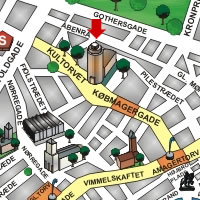
Location
The Round Tower in the Latin Quarters of Copenhagen
and right on a part of the pedestrian street named “Købmagergade”
and nearby Copenhagen’s Cathedral - Copenhagen’s
University - St. Petri Church - Rosenborg
Castle - The Kings Garden (Kongens Have)
- The Stork Fountain and Amager Square.
|
The
Round Tower
Address:
Rundetårn - Round Tower
Købmagergade 52A (Pedestrian street)
1150 Copenhagen K
Metro and Train - Nørreport station
Distance from Town Hall Square 5 km. and expect 20-30 min. by walk. |
|
|
Copenhagen
- Travel Agent and Tour Operator - Denmark |
|