| Rosenborg
Castle - King Christian IV's Castle
Rosenborg
Castle is King Christian IVs Castle – He built Rosenborg –
He lived all his life at Rosenborg – He died at Rosenborg.
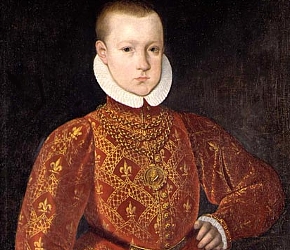
| King
Christian IV as a boy painted in 1585 by Hans Knieper.
He officially succeeded the Danish throne in 1588, just
11 years old and later crowned in 1596 at Copenhagen's
Cathedral. The King was born at Frederiksborg Castle in
North Zealand and near the town of Hillerød –
almost 40 km from the city centre of Copenhagen, but spent
most of his childhood at the old medieval Copenhagen Castle
from 1370s, where the present Christiansborg Palace is
situated. |
|
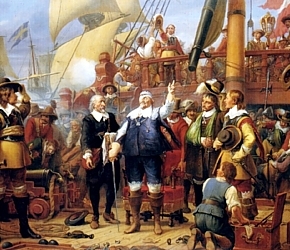
| In
the Thirty Years' War with Sweden, King Christian IV
demonstrate a heroism that is remembered by the Danish
Nation and glorified is name for ever, as he on the
deck of the battleship -Trefoldighed - (Trinity) in
1644 at the Bay of Kiel was hit by splinters of wood
and metal by a exploded canon that wounded him several
places and blinding one eye. The King’s bloody
clothing from this event is displayed at Rosenborg Castle.
|
|
King
Christian IV
Beside of being the most famous King in the list of Danish Sovereigns
and known by any purple and adult in the kingdom of Denmark –
King Christian IV was also a very popular and enterprising
Monarch, who ruled Denmark and Norway from 1588 until
his death in 1648. King Christian IV was the son
of King Frederik II (1553-1588 – ruled Denmark
and Norway 1559-1588) and was born at Frederiksborg Castle in North
Zealand in 1577. He succeeded to the throne in
1588 only 11 years old and was
later crowned at the age of 19 at Copenhagen Cathedral
in 1596. The King resided at the old medieval and
cramped Copenhagen Castle - and at Frederiksborg
Castle – nearly 40 km from Copenhagen.
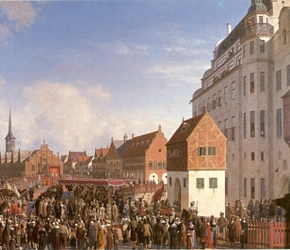
| A
Royal ceremony in 1660 was held outside of the square
of ancient Copenhagen Castle, on the right of the painting
by Heinrich Hansen, to acclaim King Frederik III as the
heir to the throne. King Christian IV lived here until
he moved out to his is little summer residence –
Rosenborg. In the middle of the painting is the Old Stock
Exchange from 1620, and on the left the naval church “Holmens
Kirke” inaugurated in 1619. Both properties were
built by King Christian IV. |
|
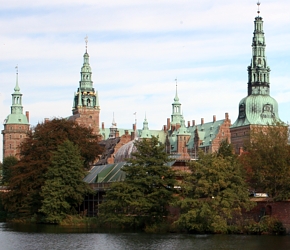
| King
Christian IV’s birthplace Frederiksborg Castle was
rebuilt by the King at the beginning of the 17th century
and was used as a Royal residence until the Royal Family
moved into Rosenborg Castle around 1610. In 1850s the
Castle was again used by King Frederik VII as a Royal
residence and in 1859, while he was in residence - a heavy
fire destroyed almost all of the Castles interior and
other valuable artefacts. Today – the Castle houses
the Museum of National History. |
|
King
Christian IV and Rosenborg Castle
As
a young Monarch King Christian IV had many building
projects on the planning stage and one of his first achievements
was to establish a new park area in Renaissance Style outside of
Copenhagen in the beginning of 1600s called Kongens
Have “The Kings Garden”. At that time
the King and his family resided in the city at the old outdated
Copenhagen Castle from about 1370, which was patched
together and rebuilt several times by many sovereigns. As King Christian
IVs preferred residence Frederiksborg Castle was situated 40 km
away from Copenhagen, he decided to build a summer residence closer
to the city – and place the Royal estate in the newly developed
“Kings Garden”, and named it Rosenborg Castle.
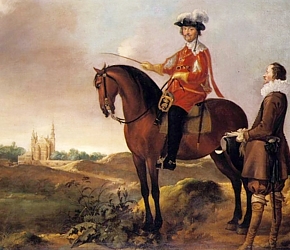
| King
Chriatian IV on horseback in 1638 outside the ramparts
of Copenhagen overlooking his beloved Rosenborg Castle,
which was completed a few years earlier in 1634. |
|
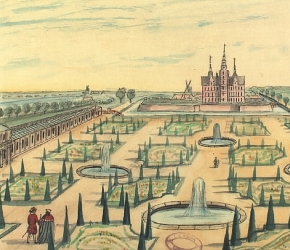
| Rosenborg
Castle in 1749 with the huge park in Renaissance style
called the "Kings Garden", and the kitchens
garden as well as the orangery on the left of the painting. |
|
Rosenborg
Castle 1606-1634
In 1606 the actual landscaping of the park area
called "The Kings Garden" (Kongens Have) began and at
the same time building construction of Rosenborg Castle started
and later developed in stages over a period of almost 22
years. The first building was a two storey mansion in Dutch
Renaissance style with one tower on the west side - and in 1611
an extra gate tower and drawbridge was built. Extension of the Castle
took place between 1613 to 1615, which turned it
into twice the length and size, and later between 1616
and 1624 the Long Hall (The Knights'
Hall) was added as a extra story to the Royal property together
with the Great Tower on the west side of the Castle
and the former two eaves chambers were converted into the existing
spire-crowned towers on the east side – which changed the
little summer residence from 1606 into a fashionable
and comfortable residence for the Royal Family and Household. The
Castle still needed a presentable entrance, which was built when
King Christian IV was to host the extravagant wedding of his son
the Prince Elect Frederik (III) and Princess Magdalena
Sibylla in 1634.
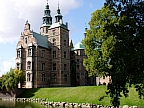
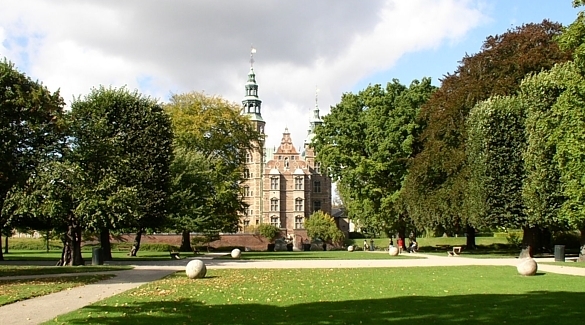
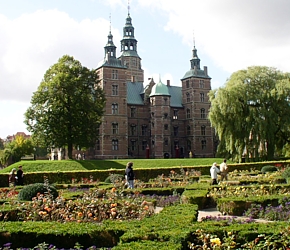
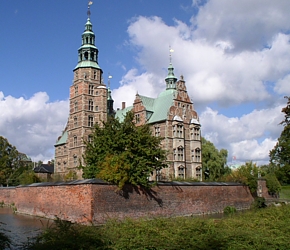
| The
present Rosenborg Castle with its beautiful rose garden
park. The two spire-crowned towers on the east side was
reconstructed in 1616 and the main entrance in the middle
was built in 1634. |
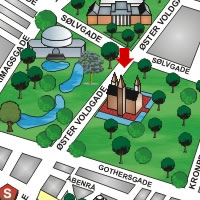
|
| Rosenborg
Castle seen from the west side with the Great Tower from
1616. The moat around the Castle premises is the remains
of the old rampart and city moat that surrounded Copenhagen. |
|
The Royal residence Rosenborg
Most of his adult life King Christian IV lived at his beloved Castle
Rosenborg. The King had his quarters in the northern part of the castle
and the Queen had her chambers in the southern end. The central part
of the Castle was reserved as the Kings Audience room
as well as the antechamber and the Great
Hall was one of the most visited places at the Royal Court.
The Kings normal menu at suppertime often consist of 16-20
assorted dishes and when Royal Banquets and stately events took place
in the Great Hall, the menu for the feast presented the guests with
up to 38 different culinary courses and unlimited
beer and wine as well as Royal entertainers. The Castle was at that
time outside the ramparts of Copenhagen, with its own well assorted
kitchen and flower gardens plus a large orangey that supplies fresh
vegetables, herbs and fruit for the Royal kitchen as well as flowers
for the Royal apartments and for decorations at Banquets. King Christian
IV died at Rosenborg Castle in 1648 at the age of
70 and is buried in Roskilde Cathedral,
where tourists and visitor can see his Sarcophagus in King
Christian IV’s Chapel.
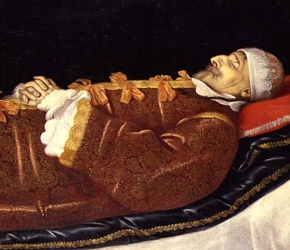
| King
Christian IV on his deathbed at Rosenborg Castle on the
28th of February 1648. His favorite daughter Leonora Christine
closed his eyes, when he dies peacefully in the afternoon
without any pain in his beloved Castle. The Prince Elect
Frederik (III) succeeded the throne after his father and
lived at Rosenborg until his death in 1670. |
|
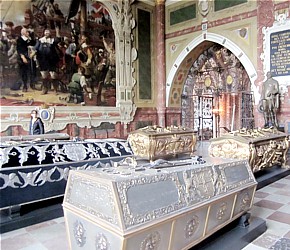
| King
Christian IV is buried in Roskilde Cathedral together
with is wife Queen Anna Cathrine of Brandenburg and
both Sarcophaguses are places in King Christian IV's
Chapel together with other Monarchs from the Oldenborg
dynasty. The bronze statue of King Christian IV is made
by famous Danish sculptor Bertel Thorvaldsen. |
|
Rosenborg
Castle after King Christian IV
Rosenborg was used as a Royal residence until around 1710,
when King Christian IV's great grandson, King Frederik IV
(1671-1730 – ruled Denmark and Norway 1699-1730) left it in
favour of his new and more suitable summer residence Frederiksberg
Castle built in 1699. Rosenborg Castle became
instead a Royal museum and the setting for the Royal
collections as well as King Christian IV’s marvellous personal
collection and historical artefacts together with the many well preserved
pieces of interior, which are quite matchless relics today.
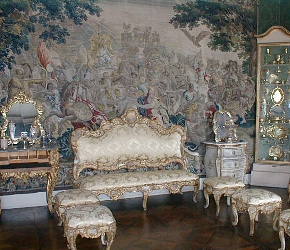
| Interior
in King Christian VI's room at Rosenborg Castle with tapestries
displaying the life of Alexander the Great. The room was
the former bedroom of Princess Sophie Hedevig, who was
the sister to King Frederik IV. Many of the rooms at Rosenborg
are equipped with the original furniture. |
|
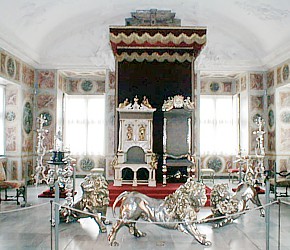
| The
thrones of the Danish Kings and Queens were used from
1671 to 1840, when the last Danish Monarch was anointed
and crowned as King. The Kings throne is made of pure
narwhal tusk in 1662 and both thrones are placed in the
Great Hall with the symbolic silver lions in front. |
|
Royal Residence again in 1794 and 1801
After 1710 Rosenborg Castle was used twice as Royal
residences in a very short period. In 1794 when
the second Christiansborg Palace was raised by
fires and the reigning King Christian VII and family
became homeless the Rosenborg property was taken in to use and in
1801, when the British army attacked the city during
the naval Battle of Copenhagen.
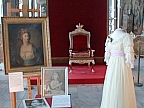
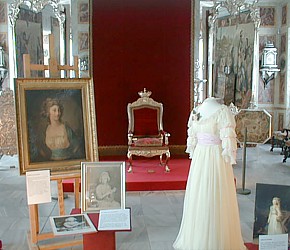
| Many
types of special exhibitions are on display at Rosenborg
Castle such as decorative art, furniture and fashion garments
as well as personal belongings to Royal members of the
Oldenborg line. The Rosenborg museum has an extra large
collection of objects and artefact that particularly is
taken into use for extraordinary presentations at the
Castle. |
|
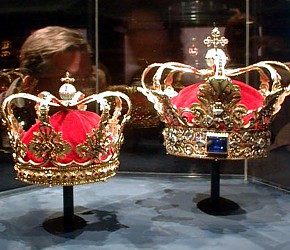
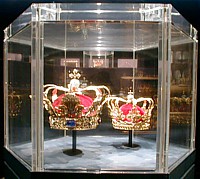
| The
Crown of King Christian IV was specially designed and
made for his crowning in 1596 by the Royal Goldsmith Dirich
Fyring from Odense, and is one of the most precious artefacts
among the Crown Jewels in the Treasury section beneath
Rosenborg Castle. The Crown in solid gold is equipped
with enamel, pearls as well as table cut stones and weighs
almost 3 kg. |
|
Museum
- Crown Jewels - Kings Garden
In 1838 Rosenborg Castle was opened as a museum
to the public with the Royal Crown Jewel and the
Danish Crown Regalia kept safely in the castle
cellars. The castle museum enlightens the history of the Danish
Oldenburg Kings through 300 years, from King
Frederik II in the late 16th century to
King Frederik VII in the 19th century.
After the abolishment of Absolutism in 1849, the
Royal castles and palaces became state property. In 1854
the last Oldenburg King Frederik VII agreed with the state that
the collection was to become entailed property passed on from King
to King. The Kings Garden (Kongens Have) was open
to the public in the beginning of the 1700s, and
has since been a very popular retreat as well as a great picnic
area for Copenhageners in the centre of city. The entire historical
venue at Rosenborg draws nearly 3.0 million visitors
every year.
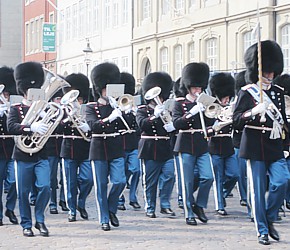
| The
Royal Life Guards marching from the drill grounds of Rosenborg
Castle to Amalienborg Palace for the ceremonial changing
of the guards. The drill and exercise grounds at Rosenborg
were established in 1730 by King Frederik IV. |
|
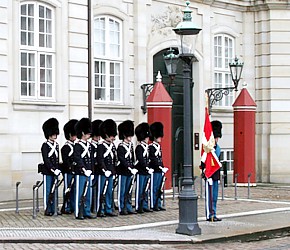
| The
main duty of the Royal Life Guards is to protect the Royal
Family wherever they are in residence in Denmark. The
Royal Guard Regiment was founded in 1658 by King Frederik
III, and has a permanent Guard unit at Amalienborg Palace. |
|
The
Royal Guards at Rosenborg
Beside of protecting the Crown Jewels at Rosenborg Castle the
Royal Guard founded in 1658 by King
Christian IV’s son King Frederik III
(1609-1670 – ruled Denmark and Norway 1648-1670) – the
Royal Guards also protects the Royal Family wherever they reside
in Denmark. Just next to Rosenborg Castle is the barrack and drill
ground of the Royal Guards, which was established around 1730
during the reign of King Frederik IV (1671-1730
– ruled Denmark and Norway 1699-1730). Visitors can follow
the Royal Guards marching from Rosenborg Castle at 11:30
am to the present Royal residence Amalienborg Palace,
when the Guards exercise the ceremonial changing of the guards at
12:00.
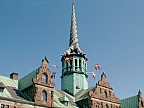
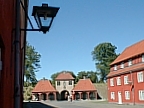
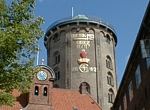
King Christian IVs buildings
King
Christian IV was recognized as the great architect and builder
of Copenhagen and during his reign he built and re-establish the most
remarkable Renaissance buildings and properties ever seen in history
and that are historic landmarks spread all over the city and North
Zealand. The best known buildings outside of Copenhagen are the restoration
of Kronborg Castle from 1629-1639
as well as Frederiksborg Castle from 1600-1620
- and some of the buildings erected by the King in and around Copenhagen
includes King Christian IV’s Brewery from 1608
- the Naval Church from 1619 (Holmens
Kirke) - the Stock Exchange from 1620
- the Old Citadel from 1625 - the
Round Tower and observatory from
1642 - and last but not least his beloved and most
crowning achievement Rosenborg Castle from 1606–1624.
|