Hans Christian Andersen - Final Resting Place

*A Part of the Danish Cultural Heritage*


Hans Christian Andersen - Final Resting Place in Copenhagen 
Return Sightseeing Return History Return 2005
 
Hans Christian Andersen
Final Resting Place in Copenhagen
Hans Christian Andersen
(2 April 1805 to 4 August 1875)

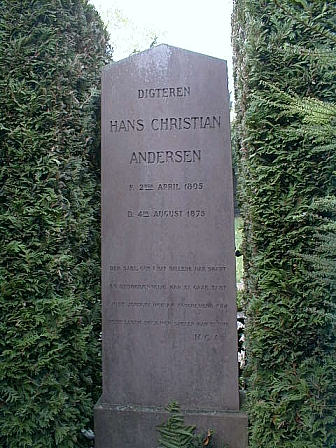
The famous Danish fairy tale writer Hans Christian Andersen's final resting place is in Assistens Cemetery in Copenhagen at section P no. 32.

After several years of serious illness, Hans Christian Andersen died in his home in Rolighed on August 4, 1875.

Hans Christian Andersen is buried at Assistens Cemetery (Kirkegård) in Copenhagen in a burial plot he originally shared with his friend, Edvard Collin, and Collin's wife, Henriette.
Around 1920, when certain public criticisms arose concerning the Collins´ treatment of their "adopted son", Andersen, a descendant of the Collin family had Edvard and Henriette's tombstone moved to the family plot at Frederik's Cemetery so that Andersen's tombstone now stands alone.


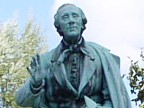
Hans Christian Andersen's sepulchral monument at
Assistens Cemetery.


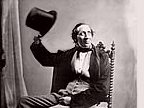
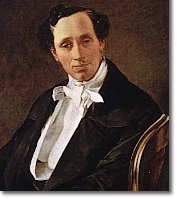
Portrait of H. C. Andersen who wrote more than 190 stories and fairy tales.


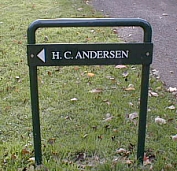
Sign at the Cemetery will guide you directly to H C Andersen's grave.
 

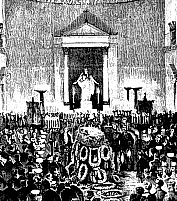
H C Andersen's funeral was held at the Cathedral of Our Lady in Copenhagen 1875.


Hans Christian Andersen's funeral was held at the Cathedral of Our Lady in Copenhagen on August 11., 1875.

Many people and celebrities participated, including King Christian 9. and prince Frederik 8., at Hans Christian Andersen's funeral, which was formed as a national day of mourning.

The Cathedral of Copenhagen was consecrated in 1829. The foundation stone was laid by King Frederik VI in 1817, and on Whitsun Day 1829, the church was ready for its solemn consecration.
The site has housed a church since 1209.
 
Visiting Hans Christian Andersen's grave
It takes only 14 min. by bus 5A from the Town Hall Square to Assistens Cemetery in Copenhagen.
Brief Biography about Hans Christian Andersen
Hans Christian Andersen's fairy tales and stories (about 190 in all, written 1835-1872) are addressed to both adults and children and are stylistically and thematically deeply original. In addition he wrote novels, travel accounts (he spent a large part of his life travelling abroad), poems and works for the theatre (including libretti for operas and ballad operas).
Although Andersen's work has its roots in Romanticism he is a modern spirit thanks to his social experience, his psychological insight, his belief in progress and industrial development.
The special quality in his fairy tales is also precisely the combination of poetry, fantasy tale and everyday reality.


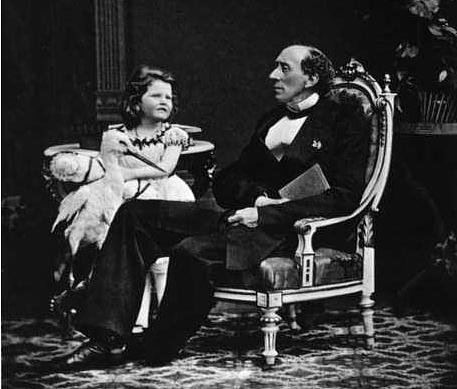
Latest photo taken in 1875 of Hans Cristian Andersen.
 
Thanks to his fairy tales and stories, Hans Christian Andersen, is probably the most widely read author in the world today, but even in his own time he was read and known from Russia in the east to America in the west.
His career from the lowest stratum of society in his native town of Odense in Funen via his problematic adaptation to the official and bourgeois circles in Copenhagen and further still until he became a familiar guest in the country mansions of Denmark, the palaces of kings and princes and the entire cultural stage of Europe provided him with material for many of his works and for no fewer than three autobiographies, the final version being "Mit Livs Eventyr" (1855, The Fairy Tale of My Life (with later supplements).
Modern editions of his correspondence and diaries have produced an unusually comprehensive insight into his life and his complex personality

To be continued!


Copenhagen-Portal
GBM & Co © - Digital Publishing and Internet Service - E-mail: info@copenhagenet.dk - Disclaimer