The Botanic Garden
Four Botanic Gardens in Copenhagen
The
University of Copenhagen’s first Botanic Garden was founded
in the central part of the old city in around 1600,
and the second near Frederiks Hospital in 1752
by the initiative of King Frederik V (1723-1766
– ruled Denmark and Norway 1746-1766).The third Botanic
Garden was placed in 1778 at Nyhavn
near Amalienborg Palace and the present Botanic Garden, the
fourth in the succession of university gardens, was established
in 1872 on the former fortifications area of
the city. The rock gardens and other higher areas are part of
the old ramparts, while the lake is a remnant
of the former city moat.
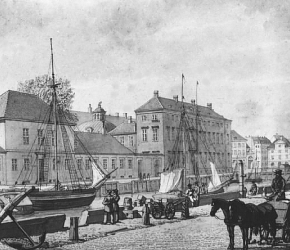
| The
third Botanic Garden was established in 1778 beside
the Charlottenborg estate right up to the canals
of Nyhavn and near Kongens Nytorv (Kings Square).
The picture is from 1840. |
|
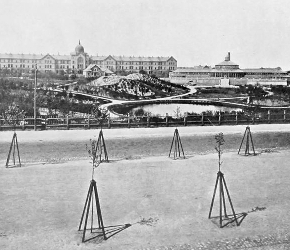
| The
present Botanic Garden in 1875 with the Palm House
in the back. The garden was placed in beside the
new municipal hospital of Copenhagen and opened
to the public on October 1874. |
|
An Institute with living plant
The Botanic Garden is an Institute within the University
of Copenhagen and has quietly developed and integrated
into the capital of over 1.5 million people, with an enjoyable
mix of landscaped lawns, formal gardens,
lovely lakes and greenhouses. The institute
cultivates a large collection of living plants for research,
education and general information, with the aim of increasing
the botanical knowledge and awareness of nature on a national
as well as on a global scale. The Botanic Garden displays Denmark's
largest collection of living plants and houses the
only gene bank for wild species. A very interesting attraction
in the Botanical Garden is also the more than 400 years
old cactus called Golden Barrel Cactus.
| The
new Palm House in 1874, with the large glass surfaces
that covered more than 2,500 m² including the
four attached greenhouses. The Crystal Palace greenhouse
in London was used as a source of inspiration for
the Palm House construction. |
|
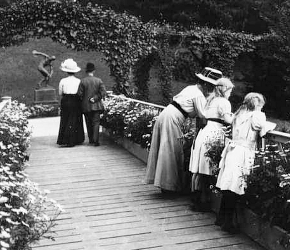
| The
flowered bridge over the lake in 1917, with the
statue of the discus thrower in the back. The lake
was the remaining of the original moat that once
surrounded the ramparts of Copenhagen and today
a fresh water habitat for a rich birdlife. |
|

The Palm House
Around the 10 hectares of the Botanic Garden
there are many interesting features and collections of various
and seldom species. The 19th century Palm House has a lot of
tropical and subtropical plants, orchids, cacti
and other succulents, and a historical collection
of Cycads. Other greenhouses display collections
of orchids from Thailand and plants from Madagascar as well
as Bromeliads and insectivorous plants. The brewer and owner
of the Carlsberg brewery J.C. Jacobsen was
chairman of the committee that established the Botanical Garden
and had experience the Crystal Palace greenhouse
in London, which gave him the inspiration to build a big modern
Palm House and four other green houses with
large glass surfaces that covered more than 2,500 m2. The Palm
house was completed 1874 with a tropical rainforest
and tall tropical trees as pineapple, mango and Cocoa.

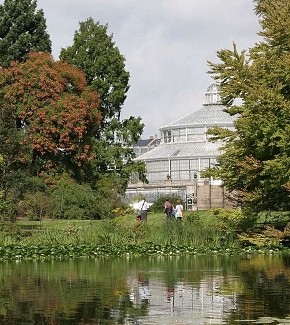
| The
Palm House, with its tropical and subtropical plants
situated beside the beautiful garden lake and occupying
a focal position in the park, which is a central
meeting place for ideas and relaxations. |
|

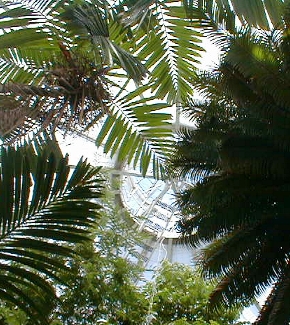
| Inside
the tropical Palm House are many wild species and
a historical collection of Cycads and a magnificent
range exotic plants. The Palm House is an oasis
for flower lovers and gardening fans. |
|
The
largest collection of annuals
In the outdoor section one can find arctic and alpine plants,
wild Danish plants, perennials, annuals
(probably the largest collection in the world), and
tuberous species such as Cyclamen, Crocus
and Fritillaries.
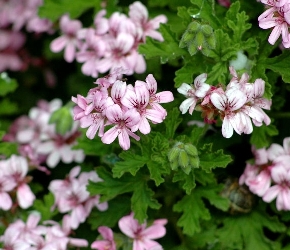
| The
annual plants in the Botanic Garden is probably
the largest collection in the world - and spread
all over the garden area - here is the Pelargonium
sort, which is a common plant found in more than
200 species and variations. |
|
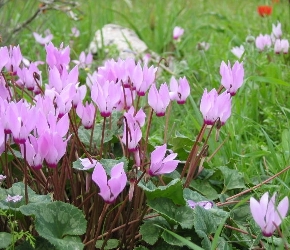
| Cyclamen
persicum growing wild and traditionally classified
in the family Primulaceae. Cyclamen is a genus of
20 species of flowering plants that typically grow
in dry forest or scrub, where they are partly shaded
from intense sunlight. |
|
Thousand
and thousand of living specimens
In the Botanic Garden of Copenhagen there are 25 thousand
living specimens represented and a total of more than 13 thousand
species. In comparison, the total flora of Europe numbers
some 11 thousand species, and the total world flora of higher
plants is estimated to be between 260 and 300 thousand species.
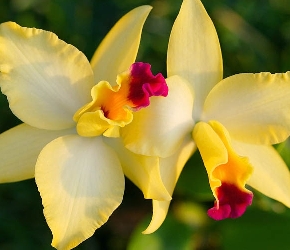
| Many
types of different orchids are grown in the greenhouses
and are some of the garden’s most valuable
plants with a historic background - as some are
collected on Danish expeditions in the 1800s. Here
is the yellow orchid in full blossom. |
|
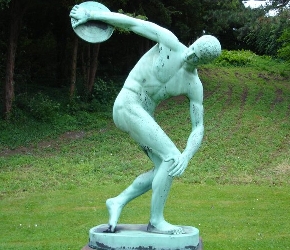
| Antique
statues are placed alongside the many paths and
green pavements in the Botany Park - and is a
natural enchantment for visitors - here the statue
of the discus thrower, which is a copy of the
original by Myron from 430 B.C..
|
|
Visitors
to the Botanic Garden
The major part of the Botanic Garden is open and approachable
for visitors as well as almost all outdoor sections, like
the Palm house and the greenhouses with orchids, bromeliads,
succulents etc. Nevertheless certain assortments and parts
in the garden are not open for guests as these specific sections
are reserved for researchers, teachers and students in connection
with their studies and ongoing educational projects.
Location
The Botanical Garden is beautifully located near Rosenborg
Castle - The National Gallery, Nørreport Station and
few minutes from the pedestrian street "Strøget".
Free entrance.
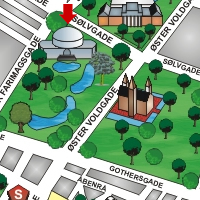
| The
Botanic Garden
Address
Botanic Garden - Copenhagen University
Oester Farimagsgade 2B
1353 Copenhagen K
Busses: 14 - 40 - 42 - 43 - 5A-6A-150S - 350S - 173E
Trains – Nørreport station
Metro – Nørreport Station
|
|
|