Christiansborg Palace - Copenhagen

*A Part of the Danish Cultural Heritage*


Christiansborg Palace - The Danish Parliament 
Return Interactive Map Sightseeing Index Return previous
 
Online Sightseeing - Copenhagen
 
Christiansborg Palace - The Danish Parliament


10 - most popular tourist site
 

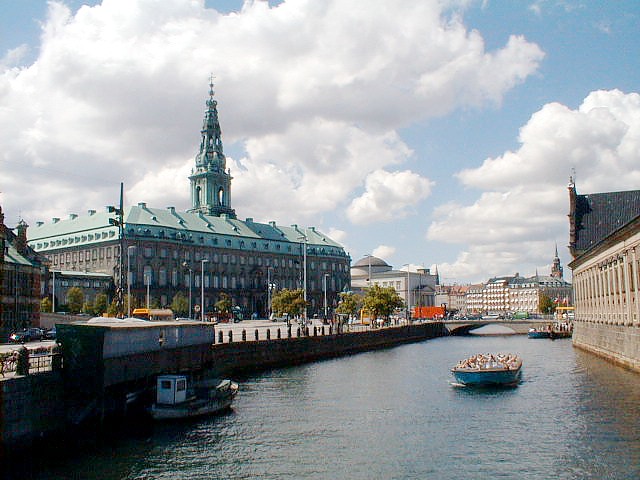
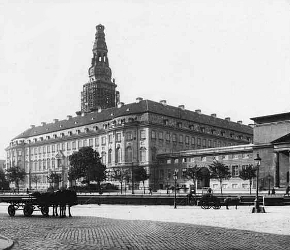
The third Christiansborg Palace was finally completed in 1928 and houses the Danish Parliament.

The 5 Castles

5 Castles on the same site

Christiansborg Palace and "Slotsholmen"
The existing Christiansborg Palace from 1928 is the fifth castle that has been built on the same area inside the grounds of Slotsholmen Island - also called the Castle Island, which is surrounded by canals, bridges and many historical buildings.

Absalons Castle
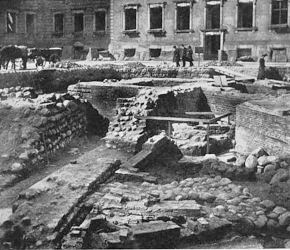
It was on this site the founder of Copenhagen, Bishop Absalon built his castle between 1167 and 1176 to protect the city against enemy attacks from the Sound and seaside. According to the history books and other legends, Copenhagen was founded in 1167. Absalons Castle was built of limestones from the Cliffs of Stevns and the ruin of this Castle can be seen under the foundations of the present Christiansborg Palace. Bishop Absalons Castle was plundered by the North German Hanseatic League in 1369, who destroyed the Castle and levelled is to the ground.

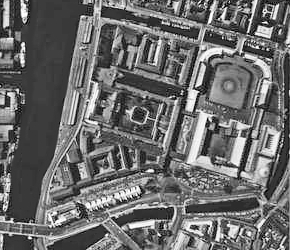
The Slotsholmen Island - also called the castle Island, where five Castles and Palaces have been built on the same spot since 1167. The 2 km long canal surrounds the Island and is connected to the mainland by 8 bridges. The Arial photo from 1957 shows the entire Christiansborg complex and the many historic buildings on this little Isle.
The ruins of Bishop Absalons Castle from 1167 on the little Isle “Slotsholmen” survived for almost 200 years before it was destroyed by the North German Hanseatic League in 1369. The rest of Absalon Castle was discovered during the excavation of the third Christiansborg Palace and can bee seen under the present foundations.

Copenhagen Castle
After the destruction of Absalons Castle in 1369 the Bishop of Roskilde ordered a new Castle to be built on the compounds and ruins of Absalon Castle and named it Copenhagen Castle. The Castle had curtain walls as well as a tall broad tower section and the property was surrounded by a nearly 2 km long broad moat with 8 bridges connected to the mainland - Sealand. In 1417 King Eric of Pomerania (King of Denmark, Sweden and Norway from 1389-1439 claimed the rights to Copenhagen Castle and moved into the new Royal premises.

Copenhagen Castle about 1730 after it was rebuilt by King Christian VI, with the extension of the "Blue Tower", which also was a state prison. The Castle was places on the foundations of Absalons Castle and was reconstructed several times by different Kings and was the Royal residence until 1730. The ruins of this Castle can be visited under the present Christiansborg Palace.
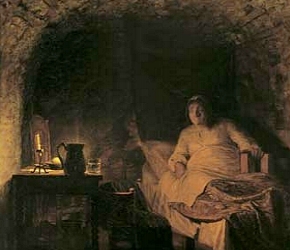
Leonora Christina, who was King Christian IVs favorite daughter, was a prisoner for almost 22 years on the upper level of the "Blue Tower" from 1663 to 1685. She was charged together with her husband Corfitz Ulfeldt for treason against the Danish State. The remains of the "Blue Tower" can be seen under the foundations of the present Christiansborg Palace.

"The Blue Tower" at Copenhagen Castle
The Castle was rebuilt several times by Danish Kings – best known is King Christian IV (1577-1648 – ruled Denmark and Norway 1588-1648) – the head architect and builder of Copenhagen, who changed the tower constructions and called it the “Blue Tower”, which also at that time had a reputation of being a horrifying and filthy state prison. King Christian IVs favourite daughter Leonora Christina (Countess of Schleswig-Holstein) was kept as a prisoner for betrayal, from 1663 to 1685, behind the walls of the “Blue Tower” by the Kings son and Leonora's half brother King Frederik III (1609-1670 – ruled Denmark and Norway 1648-1670) and his Queen Sofie Amalie for nearly 22 years – while her husband former Councillor of State Corfitz Ulfeldt had been hunted in exile for treason against the Danish State. The ruins and remains of Copenhagen Castle as well as the previous “Blue Tower” can be seen under the foundations of the present Christiansborg Palace.

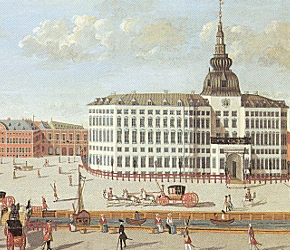
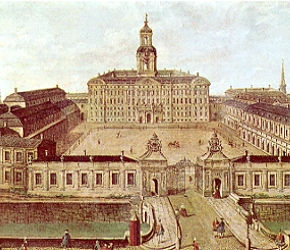
The first Christiansborg Palace was built by King Christian VI as a marvelous four wing Rococo Palace, with Show Grounds as well as a Royal Chapel - and the main Palace building was a 6 story high complex with 348 rooms, which was completed around 1745 - but functioned already as a Royal residence from 1740.
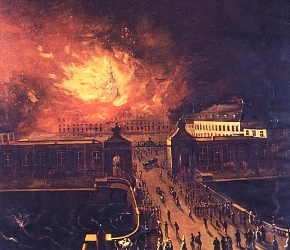
In 1794 the first Christiansborg Palace was raised by a very heavy fire that nearly destroyed the entire four winged Palace complex. The Royal family became homeless and moved with their few belongings to Rosenborg Castle and since to the vacant Amalienborg Palaces. Only the Chapel and Show Grounds outlasted the fires.

The first Christiansborg Palace
Copenhagen Castle became too small and old-fashioned for King Christian VI (1699-1746 - ruled Denmark and Norway 1730-1746), who after his accession to the throne in 1730 ordered a new castle to be built, and named after the King, as a replacement for the outdated Copenhagen Castle. The first Christiansborg Palace was designed by leading German baroque architect Elias David Häusser and the construction of the extremely marvelous Rococo palace started in 1733 and most of the Royal Palace was completed around 1745 - with show grounds and a Royal Chapel.

The Bloodless Coup and Fire
It was in these Royal premises on January 8, 1772 that a dramatic coup was carried out by Crown Prince Frederik (VI) on behalf of his schizophrenic farther King Christian VII (1749-1808 – ruled Denmark and Norway 1766-1808) against the minister in the Danish government and the King's doctor Count Johann Friedrich von Struensee and his mistress - the King's Consort - Queen Caroline Matilda, as they were both arrested in their respective bedrooms after the season's first masquerade ball was held at the Court Theatre. The chief charge against Struensee and the Queen was their criminal act against the Royal Law (Kongelov) and for taking all the power away from the King. Struensee was later condemned to be beheaded. Crown Prince Frederik and King Christian VII were the last sovereigns to reside permanently at any of the three Christiansborg estates. In 1794 the Palace-buildings was raised by a very heavy fire that destroyed all buildings with its 348 rooms - except for the show grounds and chapel.

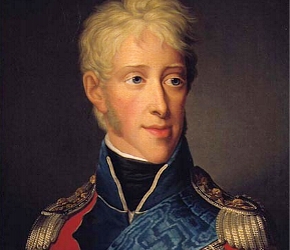
Crown Prince Frederik and later King Frederik VI was the planner of the Coup against his mother Queen Caroline Matilda and Count Johann Friedrich von Struensee to protect his sick father King Christian VII. He took over all of his father's duties as a formal regent in 1784 at the age of 16, while still holding the title of Crown Prince. After the fire had raised Christiansborg Palace in 1794, he never moved back to the new Christiansborg Palace, but settled at Amalienborg Palace permanently.
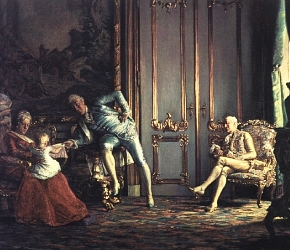
A typical idyllic family scene at Christiansborg Palace around 1771, with Queen Caroline Matilda and her daughter Princess Louise Augusta beside Johann Struensee, who was the little Princess's father. The mentally ill King Christian VII, sitting on the right, had no knowledge of the affair between the Queen and Struensee. Struensee was later arrested for treason and executed in 1772. The Queen was sent in exile for the rest of her life and died in 1775.

The second Christiansborg Palace and new Danish Parliament
After the fire of the first Christiansborg Palace in 1794 the Royal Family became homeless and had to move to other Royal premises like Rosenborg Castle and later to the Amalienborg complex for temporary accommodations, while the building of a second Christiansborg Palace was decided. The construction of the second Christiansborg Palace stated in 1803 and was led by the prominent architect Christian Frederik Hansen, who had designed the new Royal residence in French Empire Style called “classicism”. The second Christiansborg was completed in 1828, but the Palace had no longer King Frederik VI’s (1768-1839) – ruled Denmark 1808-1839 and Norway 1808-1814) interest as a Royal residence and was later only used by the Royal family and household for banquets and entertainment.

The second Christiansborg Palace was built in French Empire Style during King Frederik VI’s reign and was completed in 1828. The Palace was never used as a permanent Royal residence again - and the only Monarch, who resided her frequently, was King Frederik VII. In 1849 and after the new Danish Constitution had been signed, the elected Danish Parliament moved in to these new Royal premises.
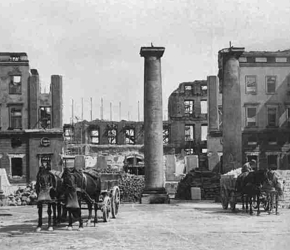
In 1884 the second Christiansborg Palace burnt down to the ground - just leaving some rooms and outer walls intact. The Palace Chapel as well as the Riding Camps and Show Grounds were saved together with other government properties located on the Slotsholmen Island. The Danish Parliament became homeless and had to move to temporary locations for the next 45 years.

New Danish Parliament and King Frederik VII
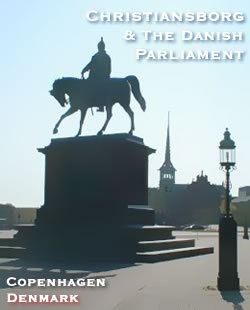
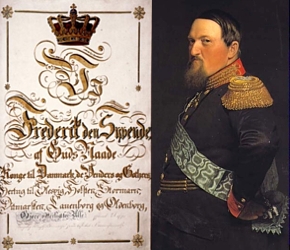
The second Christiansborg also housed the new Danish Parliament from 1849 - which had two parliamentary chambers called "Landsting" and "Folketing". The only King, who frequently resided in the second Christiansborg Castle from 1852-1863, was the last Oldenborg King and the first constitutional Danish monarch King Frederik VII (1808-1863 - King of Denmark 1848-1863), see top photo. In 1884 the second Christiansborg burnt down to ground – leaving some of the walls and few rooms intact. The Palace Chapel as well as the Riding Camps and Show Grounds were saved together with other government properties located on the Slotsholmen Island.

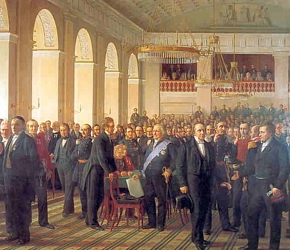
From 1849 to 1953 the Parliament had two main chambers - consisting of the Landsting and the Folketing - better known as the Rigsdag. The revision of the constitution in 1953 abolished the Landsting and enabled women to inherit the throne. Here are the National Constitutional Assembly, painted by Constantin Hansen, at their first meeting in 1848.
The new Danish Constitution signed by King Frederik VII in 1849 that finally put an ending to the absolute monarchy from 1660 and divided the Kings power into three supreme powers: The Executive Power - The Legislative Power and the Judicial Power - as well as giving the Danes their democratic and basic human rights and freedom of speech.

The third Christiansborg
After the Danish Constitution had been signed in June 5, 1849 by King Frederik VII, which put an ending to the absolute monarchy from 1660 and divided the Kings power into three supreme powers: The Executive Power - The Legislative Power and The Judicial Power, it was decided to build the third Christiansborg with premises for the Royal Family – the National Legislature (Parliament – founded in 1849) and the National Judiciary (Supreme Court - founded in 1661 by King Frederik III - 1609-1670 – ruled Denmark and Norway 1648-1670). The building of the third Christiansborg started in 1907 and was inaugurated nearly 21 years later in 1928 - with a lot of festivities and with the presence of the Royal Family as well as member of the Legislature Assemble.

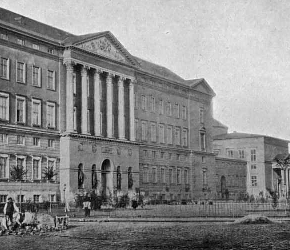
Excavation work and removal of the remaining debris in 1901 after the property was demolished by severe fires in 1884. The picture shows the early stages of the construction site, while preparing the building of the third Christiansborg Palace. The erection of the building in Neo-Baroque style started formally in 1907 and was completed 21 years later in 1928.
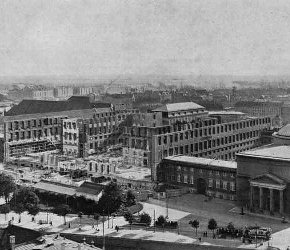
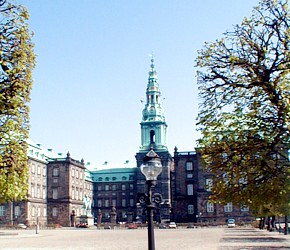
The third Christiansborg Palace in 1926, as it rose from the ground. The 106 meter high tower is under completion – still with scaffolding around the brickwork. The Palace was inaugurated in 1928 and was redesigned to house the Danish Parliament in the one wing of the building - and in the other the Royal Receptions Rooms, Supreme Court and the Prime Minister's office.

Parliament and The Royal receptions Rooms
The Palace was built in Neo-Baroque style, with the highest tower in the city, which exceeded 106 meters. The present Christiansborg Palace is separated into two main wings. The one half of the Palace houses the Danish Parliament and offices - and the other half was reserved as residential premises for the Royal Family, with the Royal Reception Rooms, the Queen's Library, the audience chambers, the Sovereign in Council rooms, the Prime Minister's Office plus the Supreme Court.
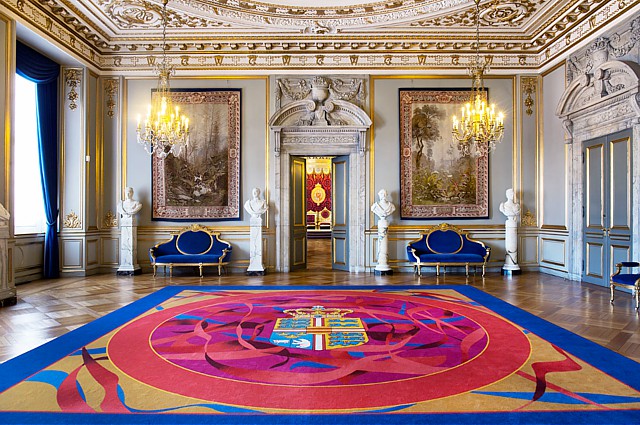
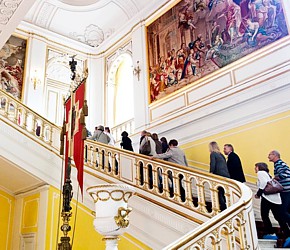
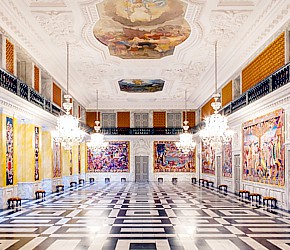
Both thrones and interior was saved, when Christiansborg Castle was razed by the last fire in 1884. Interior with beautiful parquet floors from the Royal Reception Rooms showing the elegant entrance to the Great Knight's Hall. Visitors are provided with slipper to wear over their shoes to protect the floors when visiting these Royal premises.

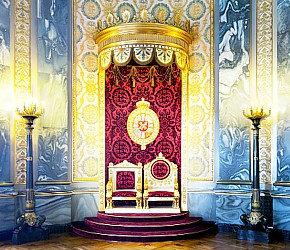
The Throne Room is a part of the Royal Reception Rooms, where Queen Margrethe receives foreign ambassadors and the Diplomatic Corps. Both thrones and interior was saved, when the Palace was razed by the last fire in 1884 together with many other historical artifacts. The Throne Room has access to the balcony, where Danish Monarchs are proclaimed in public.
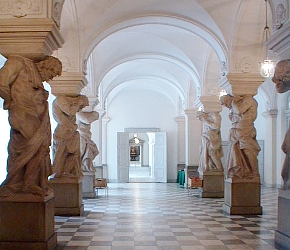
The main Royal entrance at Christiansborg that leads visitor’s right up to the Royal Receptions Rooms is placed separately at the Queens Gate on the one wing of the Palace building, and goes through the impressive entrance hall with the huge vault called the Guard’s Room (Drabantsalen). The entire arch is supported by an atlas of six Atlantes sculptures, which is carved in solid limestone.
 
The Parliament - "Folketing"

The Danish Parliament - Folketing
The Danish Parliament called "Folketing" and government quarters is situated at Christiansborg Palace right in the heart of Copenhagen.
The Folketing seats 179 elected members from many different parties and governing is still based on the Constitution from 1849, signed by King Frederik VII that opened for the Danes democratic rights.

Open to the public

Anyone is welcome to visit the Danish Parliament and see the Chamber of the Folketing as well as following the debates, when the Folketing is in session.

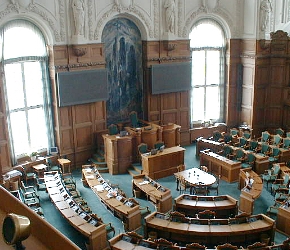
The Chamber of the Danish Folketing seats 179 democratic elected members from many different parties and governing is mainly based on the Constitution from 1849. The Parliament is placed in the one wing of Christiansborg Palace and inaugurated in 1928.
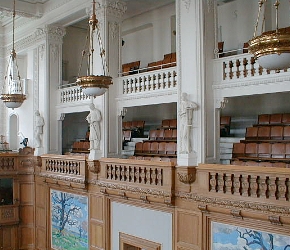
The balcony and gallery where the public can attend the debates, while the Folketing is in session. The statues on the wall represents each working class from the Danish society. The Royal Family is present every year when the Danish Parliament officially opens in October.

The Riding Grounds and Royals Stables
The riding grounds or show grounds dates back to the first Christiansborg Palace from 1745, is surrounded by the Royal stables, where more than 90 horses and 170 carriages moved into the new facilities. Above the stables the court theatre was established in 1766 and many of the room above the stables have been incorporated into office facilities for present members of the Parliament.

The show grounds at Christiansborg Palace dates back to 1745, when the first palace was built as a residence for the Royal Family.
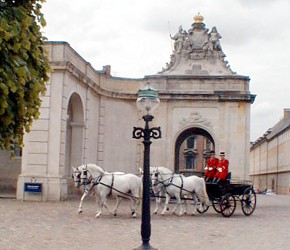
The main entrance to the Royal stables with the two Rococo pavilions on each side of the Marble Bridge from 1739.
 
Location
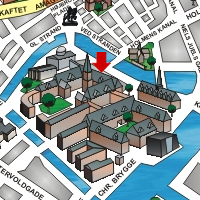
Christiansborg Palace is located on the little isle called "Slotsholmen" beside the Palace Chapel - Thorvaldsens Museum - The Royal Library - The Black Diamond - Holmens Church - The National Museum - Absalon Statue - Nikolaj Church - The Pedestrian Street "Strøget". The Danish Parliament "Folketing" and the Royal Reception Room at Christiansborg Palace is visited by more than 100,000 guests every year.
 
Christiansborg Palace - The Danish Parliament

Address:

Christiansborg Castle Prins Jørgens Gård Royal reception rooms Open: All year.

The Folketing is open for guided tours all year.
Check opening hours for guided tours.

Busses: 15 - 26 - 29 - 40 - 1A - 2A - 65E.

Trains: Central station - Metro to Kongens Nytorv.

Distance from Town Hall Square 2 km. and expect 15-25 min. by walk.
 

Return Interactive Map Sightseeing Index Return previous

Copenhagen-Portal © - Sponsored and operated by GBM MARKETING ApS - Disclaimer