|
Axeltorv (Axel Square)
The area around the Axeltorv Square is a historic
spot in Copenhagen and was once corn fields and meadows
outside the ramparts and fortification
of the city, with the major roads and lanes leading to the main
four gateway of the town. Vesterport (Western Gate),
Østerport ("Eastern Gate"),
Nørreport ("Northern Gate") and Amagerport
("Amager Gate".
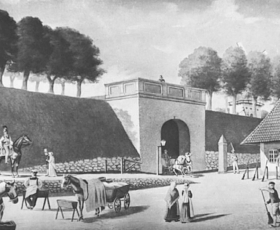
| Vesterport
in 1845 was one of four gates leading in to Copenhagen,
with the ramparts of Schacks Bastion and the Kings Mill
at the back. Vesterport gate was demolished in 1857 and
was placed where the exciting Town Hall is located. |
|
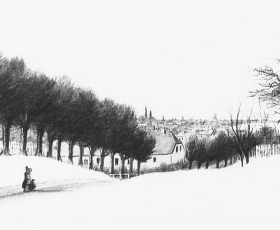
| Roskildevej
in 1853 at Frederiksberg bakke (hill) was one of the main
roads to Copenhagen via Vesterport gate into the inner
city. The road merged with Vesterbrogade and passed the
later Axeltorv Square. |
|
Vesterport
Gate
Traffic
entering and leaving Copenhagen had to pass through the city’s
four narrow town gates, which was the only access
into the old city. The Axeltorv area is located west of the city
center and outside the Western Gate (‘”Vesterport’’).
During the 1840s it was decided to dismantle the
ring of fortifications in the inner city moving the capital area’s
defenses further out and allowing the city to expand by opening
up the development of many new city districts, which caused a considerable
growth in Nørrebro, Vesterbro
and Frederiksberg.
| Vesterbrogade
crowded in 1867 with the Liberty Memorial and the end
and the high Tivoli gate entrance on the left. The Axeltorv
Square was later placed opposite the Tivoli complex. |
|
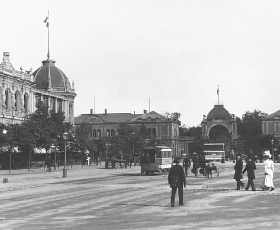
| The
area at Axeltorv Square in 1902 with the new National
Scala theatre from 1882 to the right and the circus building
from 1885 beside. To the left is the second Central Station
from 1864. |
|
Tivoli
and the second Central Station
The
Vesterbro area where Axeltorv is situated was one of the fastest growing
communities around Copenhagen in the 1840s and the
first major establishment that was built here was Tivoli Gardens
with a variety of attractions. The next major building complex was
the first Central Station built in 1847,
which was too little from the very start and replaced in 1864,
with a new Central Station on the opposite area where
the present Palads Cinema is located. The former
open square was a part of the second Central Station approach from
1864, where the main entrance to the station faced
towards Tivoli Gardens.
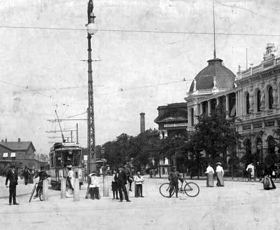
| Axeltorv
Square in 1893 with the National theatre to the left and
Tivoli's entrance portal in front. The square was a central
traffic junction due to the nearby location of the Central
Station. The tramcars were horse driven at that time and
operated on long routes through the city. |
|
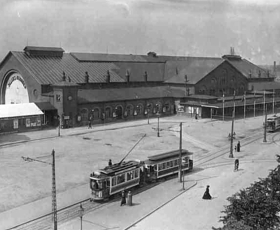
| The
second Central Station approach was a part of the later
Axeltorv Square and was replaced by he third Central Station
in 1911. Tramcar no. 4 was one of the first electric tramcars
in Copenhagen and went from the station all the way to
Klampenborg north of the city. |
|
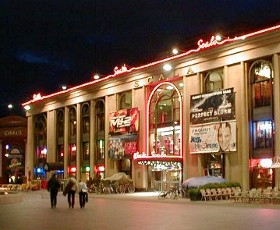
Axeltorv
as a traffic centre and National Scala
The Axeltorv Square was beginning to take form as a main
traffic centre - and in 1882 a new theatre building
called the National Scala was inaugurated on the
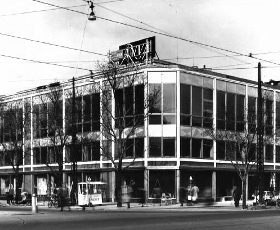
same location where the existing Scala-building is placed. The former
Scala-complex was from 1953 to 1987
once a well known department store called Anva. In
1989 the present Scala complex
was opened with shops, restaurants, fitness centre, cinema, and a
discotheque. Circus
building and World Cinema
In 1885 a new permanent round
circus building with a dome was built in the corner of
the square and opened in 1886. Up to 1990
circus shows have been performed regularly and from the early 1970s
during the winter period the circus building was changed
to a grand cinema called World Cinema. Today the
building is used for dinner and dance shows.
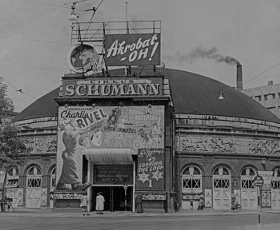
| The

so called circus building from 1885 on Axeltorv Square
in 1953. During the winter period the circus building
was changed to a grand cinema theatre called World Cinema. |
|
| From
1953 to 1987 the department store Anva was situated in
the building of the former National theatre on Axeltorv
Square and in 1989 the present Scala complex opened after
a thorough restoration. |
|
Axeltorv
formally established in 1917
In 1917 the Axeltorv Square was formally established
and named after the founder of Copenhagen Bishop Absalon.
In 1911 Copenhagen inaugurated its third
Central Station located at its present position, and replaces
the second Central Station at Axeltorv.
| The
Palads Cinema on Axeltorv Square in 1918 is the largest
cinema of its type in Denmark. The building is located
exactly where the former second Central Station from 1864
was placed and has since the very start operated as a
cinema. |
|
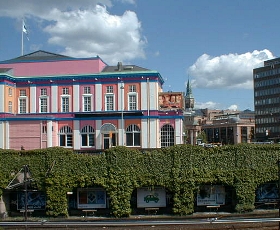
| The
Palads Cinema operates with 17 screens and is the most
colourful landmark in the city. At the back of the picture
is the Town Hall and Scala building with the circus
building to the left and Axelborg to the right. |
|
Palads
Cinema and Tango Jalousie
In 1918 the present Palads Cinema was built as
the largest in Denmark. In 1979 the gigantic cinema
complex was renovated and installed with 17 separate screens
and the latest in surround sound and comfortable seating. The building
was painted in numerous colours in 1989 and is
one of the most colourful landmarks in the city.
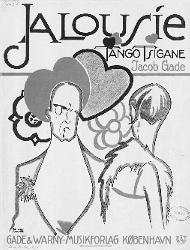
In 1921 the celebrated Danish composer
Jacob Gade (1879-1963) was the leader of the orchestra
of the Palads Cinema and in 1925 he composed the
world famous music piece - Tango Jalousie (Jealousy)
- as an accompaniment to a silent film.
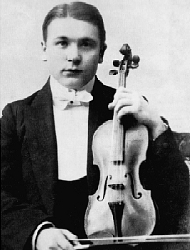
| The
composer and violinist Jacob Gade who composed the world
famous music piece Tango Jalousie in 1925, was the leader
of the Palads cinemas orchestra. |
|
| The
interior of the Palads cinema in 1918, where Jacob Gade
created Tango Jalousie and other music arrangements to
accompany silent movies. |
|
| Tango
Jalousie became a great international hit when it was
launched and is played every minute somewhere around
the world.
|
|
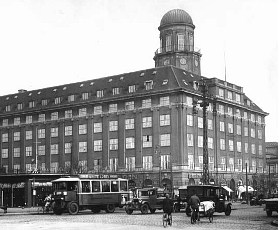
Axelborg
The
last building to be built around Axeltorv Square was the Axelborg
complex in 1920. Today the building is the
headquarters for the Danish Meat Association and the premises are
also used as a conference centre with several restaurants at the ground
level.
| The
massive Axelborg complex in 1932 was the last of the historic
building that was built around Axeltorv Square in 1920.
The present building houses the Danish Meat Association
and considerable conference facilities. |
|
| Axeltorv
Square is one of the busiest spots in the city of Copenhagen
and especially on Friday and Saturday nights the whole
pedestrianised area seems like one enjoyable party. Scala
to the left and Tivoli in front. |
|
Axeltorv
a playground for entertainment
Since
its establishment and up to now Axeltorv Square has been recognised
as a playground for entertainment and centre point for amusements
in the very heart of Copenhagen, surrounded by historic
buildings with attraction venues, shopping arcades, a variety
of small and big restaurants, dinner and show entertainment, amusement
park, music and hot nightlife, cinemas and theatres and most of all
one of the busiest spots and pedestrianised
areas in Copenhagen - a active plaza for fun-seekers
and –lovers.
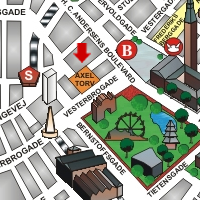
Location
Axeltorv is located near Tivoli - Scala - Circus Building - Palads
Cinema - Axelborg - Central Station - Vesterport Station - SAS-Hotel
- Liberty Memorial - Town Hall Square.
Axeltorv
Address
Axeltorv
1609 Copenhagen V
Busses:
10 - 15 - 20 - 30 - 40 - 66 - 2A - 5A - 6A - 250S
Trains – Vesterport Station –
Central Station
|
|
|